Roadside landing or log yard? How to tell them apart in satellite imagery
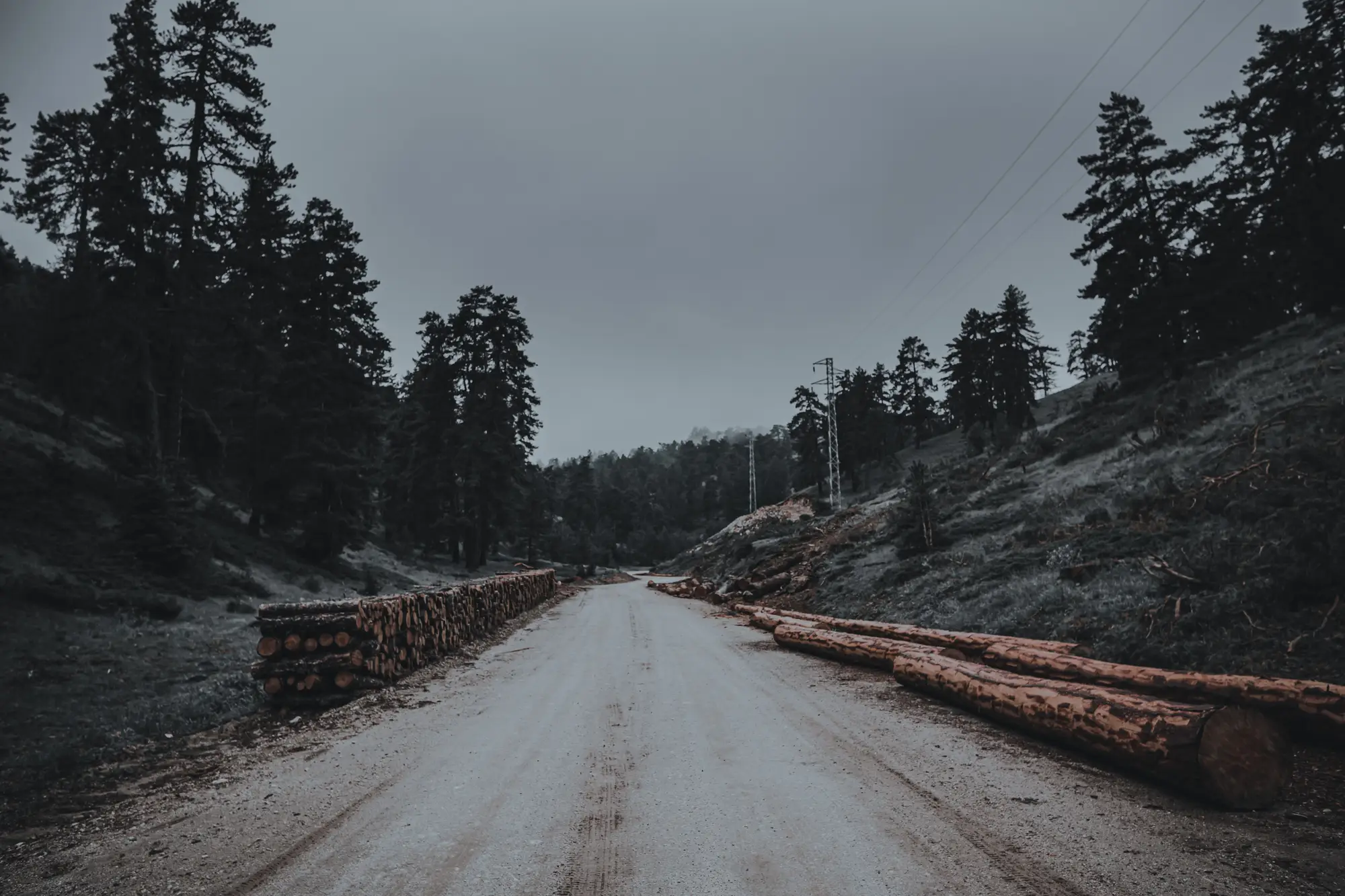
If you're scanning imagery trying to find active cutblocks, a sorting yard will trip you up almost every time. Both a roadside landing and a log yard show stacked timber next to bare dirt next to a road. Both throw the same rows of parallel shadows when the sun's low. But one tells you a crew is cutting right now, and the other just tells you a facility exists. Mix them up and you'll report harvest activity in a place where the only thing happening is inventory sitting on a scale.
Size, shape, and how long it's been there
A roadside landing is small because it only has to hold one cutblock's worth of wood until the next load-out. You're typically looking at a cleared pad somewhere under an acre, often irregular in shape because it got carved out wherever the skid trail met the road. The log decks themselves are short runs, usually a handful of piles, and they shift week to week as trucks haul out and new wood comes down from the block above it.
A log yard, mill yard, or sort yard is a different scale of thing entirely. It's a permanent clearing, often several acres, with a footprint that stays the same pass after pass because it's graded and maintained rather than carved out of the bush. Look for long, uniform log decks laid out in parallel rows with consistent spacing, sometimes sorted by species or length, which is a sorting operation's whole reason for existing. A landing crew decks logs as they come down from the block and waits for the next truck. Grading and sorting by species happens at the yard, not here.
What the access road tells you
Follow the road back from the clearing. A landing's access road is a spur, usually unpaved, cut specifically to reach that block, and it dead-ends at the landing or loops back toward a haul road. It's narrow, it's rough, and on a fresh pass you'll often see raw soil or disturbed ground along its length from recent equipment traffic.
A yard sits on an established road, frequently a numbered forest service road or something close to a highway, because trucks need to move volume in and out reliably and year-round. You'll usually see multiple access points, parking or turnaround space for several trucks at once, and sometimes a scale house or small office structure, none of which belongs at a cutblock landing.
What's parked on the pad
This is where the two get easiest to tell apart once you know what to look for. A landing has harvesting equipment on it, or equipment that's clearly just finished working: a processor or a forwarder parked at the edge, maybe a self-loader backed up to a deck. The surrounding ground shows slash, stumps, and the ragged edge of standing timber right up against the cleared area, because the crew is cutting into the block right now.
A yard has trucks, trailers, and loaders built for yard work: highway tractors, flatbed trailers, and loaders sized for moving sorted wood. The yard sits apart from any harvest unit, often miles from the nearest active block, so there's no edge of standing timber butting against the clearing. The ground around it tends to be older, more compacted, and free of fresh slash.
Put those three checks together, size and permanence, road type, and what's parked on the pad, and the two stop looking similar at all. A landing is messy, small, and surrounded by fresh cut. A yard is tidy, large, and surrounded by nothing but more road.
If you're doing this by eye across a few hundred square miles every month, it adds up fast, which is the whole reason a monthly read on where crews are actually cutting exists instead of a map that just shows permit boundaries.
Next time you're clearing a stand of imagery, check the deck shape and the road before you log anything as active. It'll save you a call to a contractor who already wrapped that block three weeks ago.