Grapple skidder vs cable skidder: reading the silhouette from above
What you're looking for
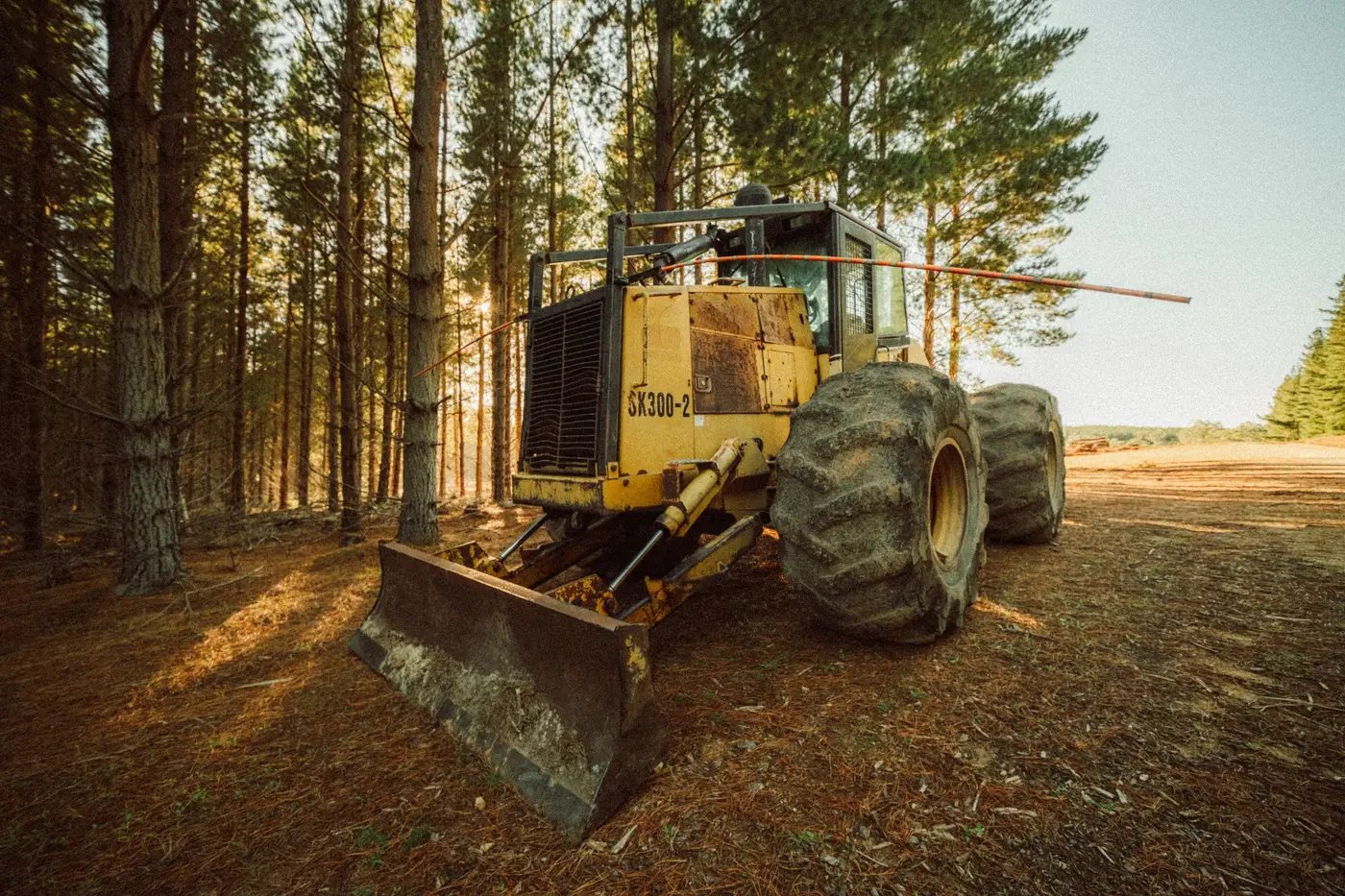
At the ground, telling a grapple skidder from a cable skidder is easy: one has a claw on the back, the other has a winch drum and a spool of cable with chokers hanging off it. From 0.5 m imagery, you don't get the claw or the drum. You get a silhouette, a shadow, and whatever the machine is doing to the wood around it.
The two machines overlap enough that a quick glance won't settle it. Both run roughly the same wheelbase, both ride on an articulated frame with the bend in the middle, both leave the same basic rutted trail. The difference you can use from overhead comes down to three things: the rear-end silhouette, what the logs look like behind the machine, and where the machine sits relative to the landing.
Rear-end silhouette and shadow
A grapple skidder carries its grapple on a boom arm that swings up and over the rear arch. In a near-nadir shot, that arm throws a shadow that reads as a short, blocky protrusion off the back of the machine, sometimes bent at a joint. It's stubby. A cable skidder's winch and fairlead sit lower and flatter, tucked under the arch, and the cable itself, if it's paid out, shows up as a thin pale line running back into the stand, sometimes 20 to 30 m. That line is the single best tell you'll get at this resolution. Trace a thread running from the machine into standing timber and you're looking at a cable skidder mid-pull.
What the logs behind it tell you
Grapple skidders tend to move whatever the grapple can close around in one trip, so the bunch dragging behind reads as tight and even, logs roughly parallel to each other. Cable skidders choke multiple logs at different points along the trail before winching them in, so the bunch behind a cable machine is often a looser fan, logs sitting at slightly different angles with gaps where the chokers grab. It's not a hard rule. A grapple operator working a messy blowdown patch will drag an uneven bunch too. But across a dozen machines in a cutblock, the pattern holds often enough to sort most of them correctly.
Where it's working also matters
Cable skidders show up more on steeper or rockier ground, where a grapple's reach doesn't do much good and the operator needs to winch wood down to the machine instead of driving up to it. See a skidder parked at the bottom of a drag with lines fanning uphill into the trees, and that's a cable skidder before you even look at the machine body. Grapple skidders dominate flatter, more open ground where the operator just drives to the wood and grabs it.
None of this replaces a clean side profile. A low aerial pass at an angle, instead of straight down, will usually resolve the grapple arm or the cable drum well enough to call it outright. A monthly VHR pass over a whole operating area doesn't give you that angle, which is why the silhouette-plus-context approach above is the one that holds up across dozens of blocks, not just the one you happened to fly low over.
Sorting one skidder from one frame by eye is a reasonable Tuesday-afternoon exercise. Knowing which cutblocks across your territory had iron on them this month, and what kind, is a bigger ask, and it's the one most sales reps need answered. Forestry Machine Census builds that list monthly, counting harvesters and forwarders by type across the cutblocks that lit up since the last pass.
If block-by-block guessing is eating your week, that's the problem this is built to take off your plate.