Forwarder vs skidder: how to tell them apart in satellite imagery
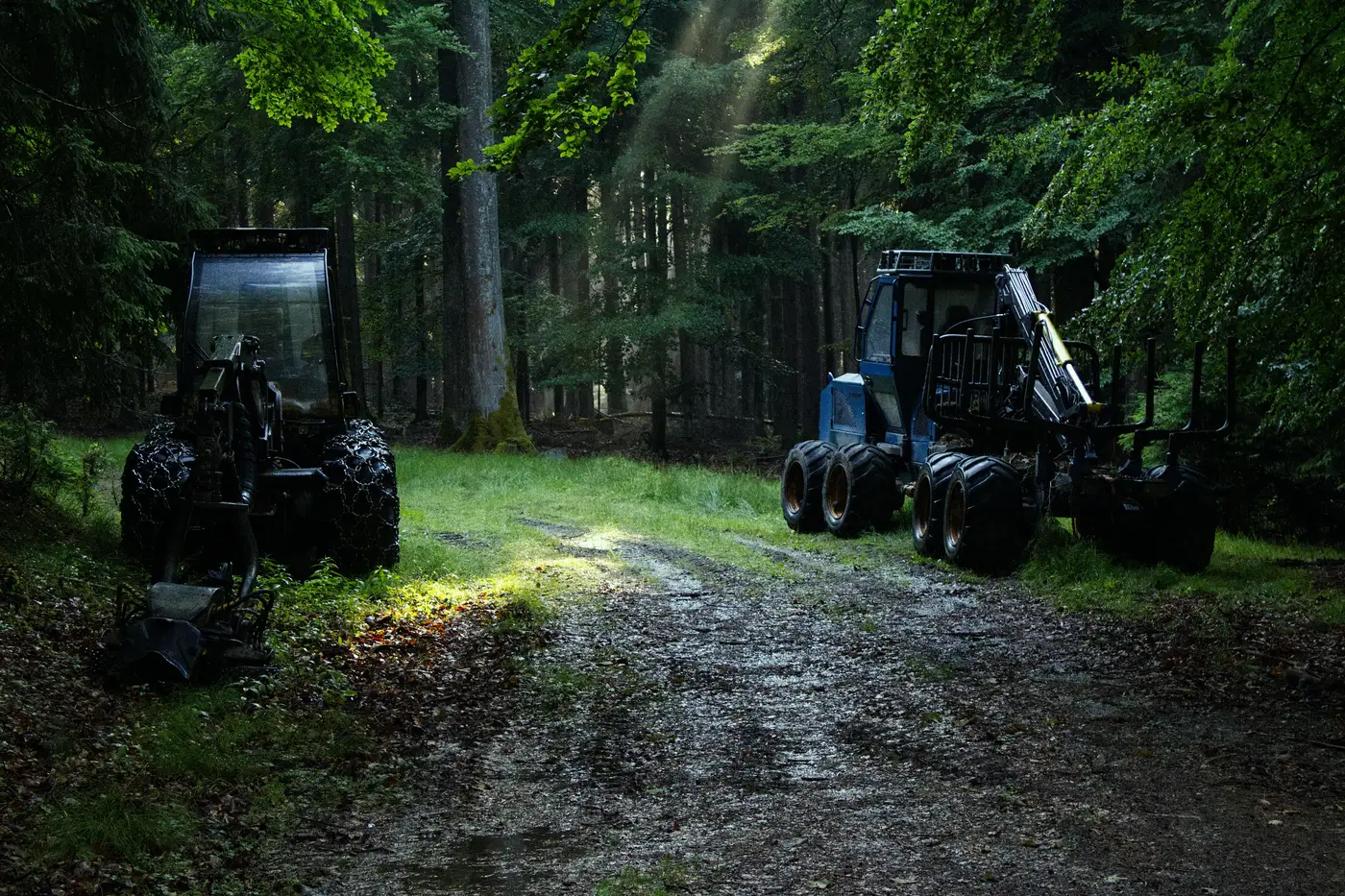
Anyone who's spent time reading cut blocks from the air knows the first problem isn't finding the machine. It's figuring out what you're looking at once you've found it. From 400 feet or 400 miles, a forwarder and a skidder can read as the same grey-brown blob with wheels. Get the ID wrong on a count and you've told a product manager there are two forwarders working a block that has a skidder and a processor instead.
The good news is the two machines don't look much alike once you know what to check. The bad news is most of the tells are in details that get lost at coarser resolution or on a hazy pass.
What separates a forwarder from a skidder in the frame
A forwarder carries its load. That's the single fact that drives everything else about its silhouette. It has a flatbed or bunk arrangement running most of the chassis length, usually with a crane mounted just behind the cab to load and unload. In imagery, a loaded forwarder shows up as a long, fairly uniform rectangle, the stacked logs reading as a tight, parallel-ridged texture across the bunks. An empty forwarder heading back into the block looks skinnier and darker, just the bare chassis and crane arm folded down.
A skidder drags its load instead. Whether it's a grapple skidder or a cable machine, the logs trail out behind the frame rather than sitting on top of it. That tail is the giveaway: a skidder pulling a turn of logs shows a machine-shaped core with a ragged, diverging fan of lighter material streaming off the back, sometimes twenty or thirty feet long depending on the turn size. An empty skidder returning to the stump shows no tail at all, just the stubby chassis and the grapple or blade up front.
A drag trail in the imagery, torn-up duff and mineral soil scraped along the ground in a line back toward standing timber, marks a skidder route. Forwarders run on brush mats or slash the operator's been laying down, so their travel lanes read as matted rather than gouged.
Reading the landing, not just the machine
A single frame of one machine is often the hardest call you'll make all month. The landing tells you more than the machine does. If you see a stack of logs growing at the roadside landing and a machine shuttling back and forth between the stand and that stack on a regular lane, that's forwarder behavior, deck-building. If instead you see logs bunched mid-block with no stacked deck yet and a machine making shorter runs with visible drag scars, that's a skidder pre-bunching for a processor or loader to work later.
Shadow length helps on a clean, low-sun pass. Forwarders tend to throw a boxier shadow because of the bunk structure and crane. Skidders throw a shorter, lower shadow off the cab and blade, with the drag load, if any, casting a separate, broken shadow pattern behind it rather than one continuous shape.
Tires versus tracks is a real distinction but less reliable than it sounds from the ground. At sub-half-meter resolution you can sometimes make out dual-tire bogies on a forwarder's rear bunks that read differently than a skidder's rear axle, but on a hazy day or a shaded block that detail disappears and you're back to shape and load as your best evidence.
None of this is a one-glance call, and we don't pretend it is. A single machine silhouette on one pass gets read in context with the track it's running, the landing it's feeding, and what showed up on last month's pass over the same block. That's the whole reason the counts in a monthly list of active cutblocks with machine tallies by type separate forwarders from skidders instead of lumping everything into a generic "equipment" bucket. A fleet manager deciding where to send the next unit needs to know which machine is actually working, not just that something with wheels is out there.
If you track territory by what's cutting right now rather than what a permit says might be, that's the list worth getting on your desk every month.