Feller buncher vs. harvester: telling them apart from overhead imagery
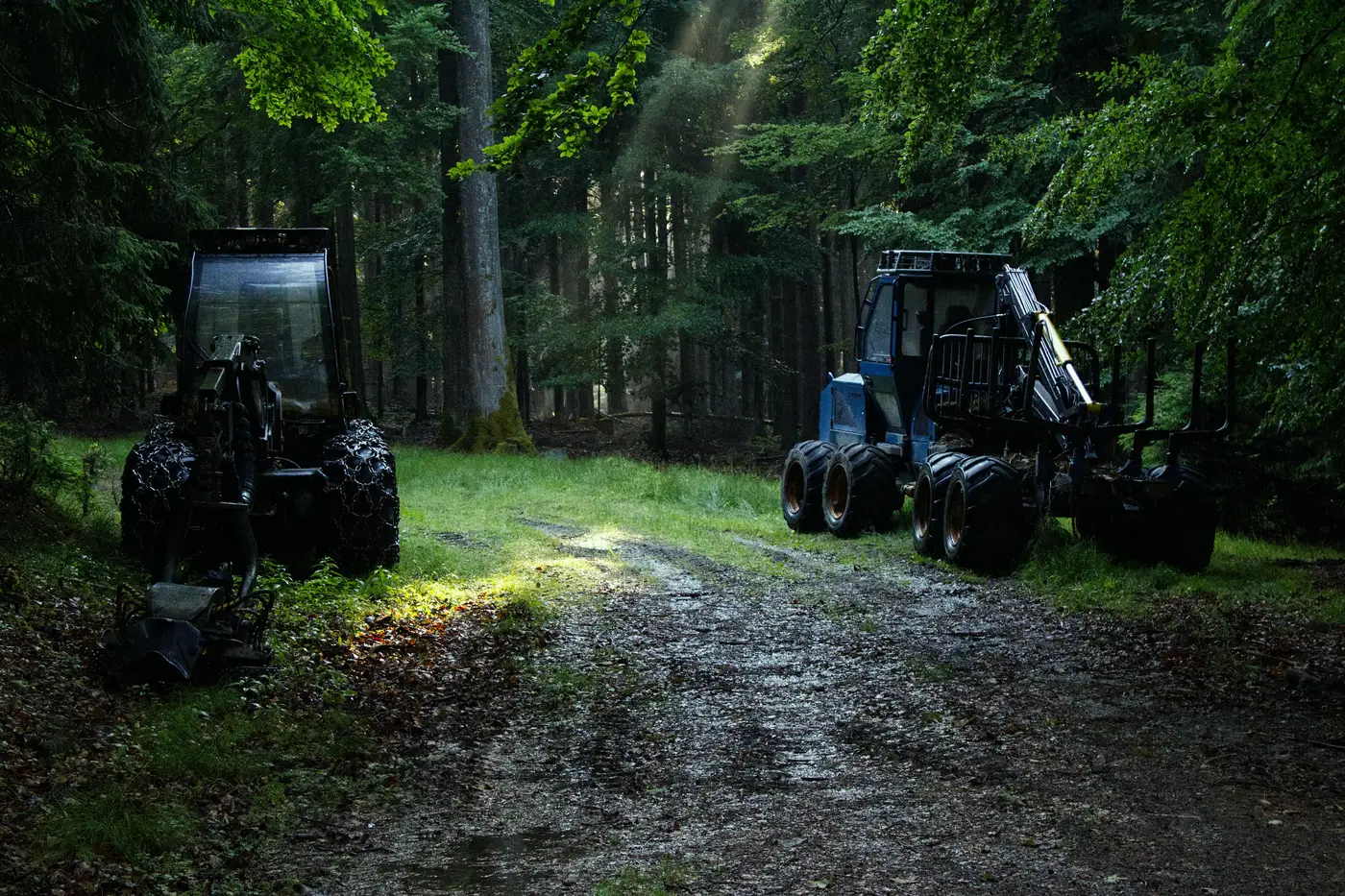
If you've ever pulled up imagery of a cutblock and tried to count what's running the ground, you've probably hit the same wall: a feller buncher and a single-grip harvester can look like the same dark blob with a stick coming off it. They're not the same machine, they don't work the same system, and for anyone tracking contractor activity by region, mixing them up throws off the whole count.
Why they get confused from above
Both machines sit on a tracked or wheeled carrier with a boom reaching out to the stem. At 0.5 m resolution or coarser, that boom is often the clearest feature you've got, and a folded boom on a feller buncher can read almost identically to a stowed harvester head. The confusion gets worse because both machines show up in active cutblocks, both leave a visible trail through standing timber, and both park near a landing between shifts. None of that tells you which one you're looking at. The pattern they leave on the ground does.
Read the wood, not just the machine
This is the fastest tell in the field, and it works even when the machine itself is a blurry shape.
A feller buncher cuts and accumulates stems without processing them. What you'll see nearby is tree-length wood, often fanned or piled in bunches, limbs still on, waiting on a skidder to drag it to the landing. The stems are irregular lengths and the piles look loose, almost scattered.
A harvester fells, delimbs, and bucks to length in one pass. The wood on the ground comes out in uniform short lengths, stacked in neat rows along the strip road, limbs and tops left behind as slash. If you can make out a cut-to-length (CTL) operation, you'll usually spot the slash mat too: a lighter, textured line running through the block where the machine laid branches down to drive on without rutting. Feller bunchers, working mostly in tree-length systems paired with a skidder, don't need that mat and won't show one.
Silhouette and boom: what separates the two
The feller buncher silhouette from above tends to be compact and front-heavy, with a disc saw or shear head that reads as a flat, roughly circular plate at the end of a short, thick boom. When it's cutting, the boom is usually close to the cab rather than stretched out.
A harvester's boom extends further and looks more like a small crane, because the operator has to swing the head out to reach standing stems one at a time rather than gathering several in close. Harvester head identification from imagery comes down to that extended reach plus a narrower, more elongated head shape at the tip, which holds the delimbing rollers even if you can't resolve them individually.
Tracked vs. wheeled harvester clues
Once you've settled on "harvester," the undercarriage tells you more. A tracked harvester has a wider, boxier footprint and shows up on steeper or wetter ground where flotation matters more than speed. A wheeled harvester has a narrower chassis, visible tire shadow rather than a track shadow, and tends to appear on flatter, better-drained sites where it can move faster between stems. If you're seeing short, frequent stops along a strip road rather than one steady track, that's usually a wheeled machine working quickly through a stand.
None of this replaces a boots-on-the-ground count, and resolution limits mean you won't pick out a saw disc or a delimbing knife. But slash pattern, boom posture, and undercarriage shape together get you most of the way to telling a feller buncher from a harvester without ever leaving the office.
That's the same read we build a monthly list around at Forestry Machine Census: active cutblocks and roadside landings, with machines sorted by type so you know who's actually cutting this month, not just who holds the permit.