Clearcut vs selective harvest: reading the signature from above
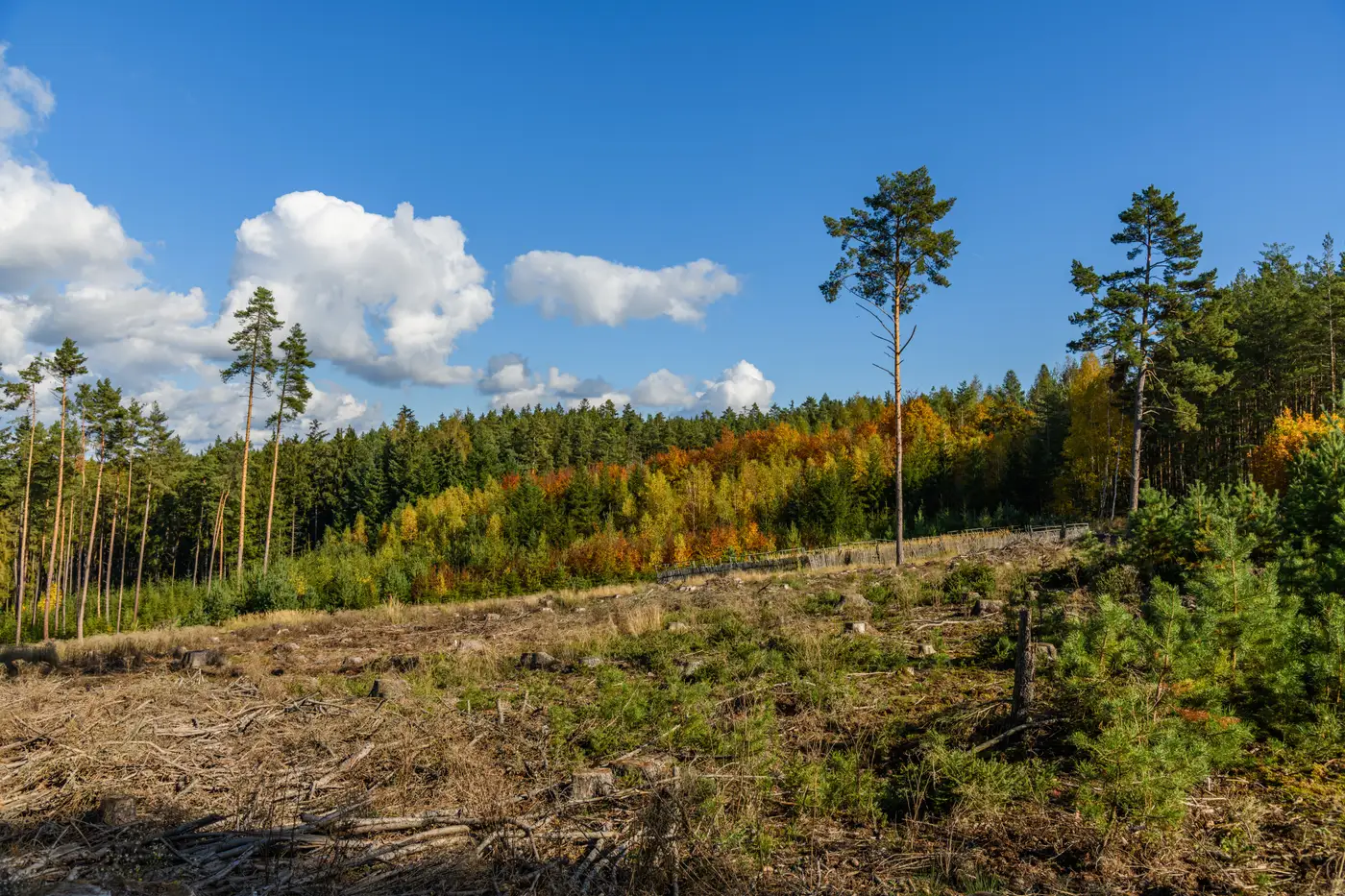
If you spend any time looking at fresh cut imagery, the first question is usually the simplest one: did this crew take everything, or did they leave a stand behind? The answer changes what you're dealing with, whether that's estimating volume, figuring out which contractor's working the block, or just confirming a cut actually happened where the permit says it should.
The clearcut signature
A clearcut reads as a hard edge. One week there's continuous canopy, the next there's an open polygon with a sharp boundary against the standing timber around it. Inside that boundary, the ground is mostly bare or covered in slash, with no meaningful crown left. You'll usually see:
- A clean, often geometric cutblock outline that follows the harvest plan rather than terrain
- Slash piles or windrows scattered or lined up across the opening
- One or more landings at the block's edge, typically where it meets a haul road
- Skid trails converging toward those landings in a branching pattern, like veins running to a trunk
The landing itself is the tell most people miss. On a clearcut, the deck tends to be large because the whole block's volume is funneling through one or two points. If you're used to reading these blocks, a landing that size usually means full removal, not a thinning pass.
The selective harvest signature
Selective and partial cuts look messier, and that's the point. The crew is picking stems, not clearing ground, so the canopy stays mostly closed when you look straight down. What gives it away:
- Small, irregular gaps in the crown instead of one continuous opening
- Skid trails that thread between retained trees rather than radiating to a single deck
- Multiple small landings or none at all, since volume per entry is lower
- Residual canopy shadow still visible across most of the unit
This is where partial cut vs clearcut imagery gets genuinely hard to call from a single pass. A light shelterwood can look, at first glance, like a block that just hasn't finished yet. The difference usually shows up in the trail density: selective cuts have more total trail mileage per acre because the machine has to work around standing stems instead of driving straight lines.
What the harvest system signature adds
Once you know it's a clearcut or a selective cut, the next layer is figuring out what system cut it. Cut-to-length operations process the tree at the stump and leave the limbs on the ground as a mat, so you'll see a lighter, brushier slash texture and smaller, more frequent landings, since the forwarder is hauling processed wood in shorter runs rather than building one big deck. Whole-tree systems skid full trees to roadside, so the landings run bigger and the slash piles concentrate near the deck instead of spreading across the block. That difference in landing size and slash distribution is the harvest system signature, and it's often a faster read than trying to count individual machines.
None of this replaces a ground check if you need to confirm species mix or exact volume. But if the question is where crews are cutting and roughly what kind of operation it is, the imagery usually tells you before any paperwork does.
Turning that kind of read into a routine is what Forestry Machine Census runs every month: a pass over active cutblocks and landings that attaches harvester and forwarder counts by type, so you've got a list of where crews are working, updated monthly.
Next time a fresh block shows up on your pass, start with the landing before you look at anything else. It'll tell you more about the harvest system than the block outline will.